What “Random” Means on a Casino Interface
Understand random casino game meaning by checking what a screen claims, where the rules add detail, and which questions about outcomes remain unanswered.
What does “random” actually tell you on a casino screen? The phrase random casino game meaning depends on the sentence it appears in: “random symbol”, “random feature” and “random outcome” point to different parts of a game. None explains more than its wording and related rules disclose.
A small label beside a game title can sound like a description of the whole experience. A note inside a bonus panel may apply only to that feature. The useful question is not simply whether the screen says “random”, but what is being selected and where the game explains the selection.
The thing named after “random” sets the scope
Look for the noun attached to the word. “Random symbol selection” refers to symbols; “random feature selection” refers to a feature. If a screen says only “random”, the missing detail matters: the label does not tell you which part of play it describes.
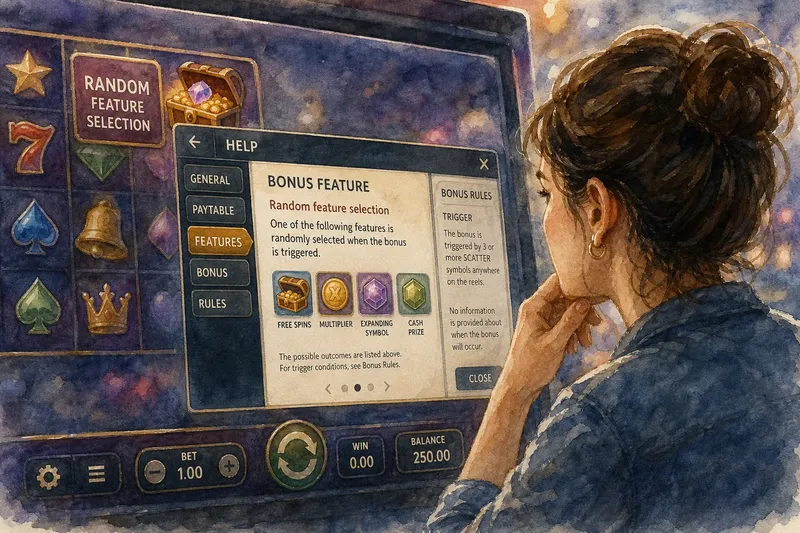
Say a hypothetical slot-style game displays “random feature selection” beside a bonus panel. The phrase describes how that feature is selected, according to the screen. It does not explain the bonus’s possible outcomes, conditions or timing; those questions belong to the rules and feature description.
Read the whole sentence before treating a short badge as a full explanation.
Trace the label to the rules that explain it
Use the help panel and game rules to fill in distinct details. The interface may name the selected element, while the rules list possible outcomes or describe when a feature can occur. A detail in one place should not be mistaken for a detail the text never gives.
- Check the noun beside “random”. If it names a symbol, feature or outcome, limit your reading to that element; if there is no noun, look for a fuller explanation and leave the scope open until then.
- Check whether the rules list possible outcomes. If they do, use the list to identify what may be selected; if they do not, do not guess what the label includes.
- Check whether a bonus description states its trigger. If it does, read those conditions separately from the word “random”; if it does not, consult the help panel or leave the trigger unresolved.
- Check whether the interface explains how an option is selected. If it does, treat that as a separate selection detail; if it does not, do not infer a method from the label alone.
- Check where the wording appears. If it sits within a named feature panel, read it as applying to that feature unless the rules say otherwise; if it appears as a general badge with no defined scope, seek a more specific disclosure.
- Check for a separate explanation of fairness or oversight. If one is provided, read its terms on their own; if not, do not use “random” as a substitute for that information.
Imagine a hypothetical player sees “random symbol selection” in a help panel. The player opens the rules and finds a list of possible symbols, but no explanation of how their chances compare. The resulting reading is specific: the label concerns symbol selection, the list identifies possible symbols, and the relative chances remain unanswered.
Placement can narrow a claim, but it cannot fill in missing rules
A label beside a game title may appear broad; a sentence in a bonus panel points more clearly to that feature. Placement helps locate the subject, but it cannot establish details the wording does not provide. Follow links to the rules and check whether they refer to the same element.
Keep descriptions separate from predictions. “Random feature selection” does not say when a feature will appear or what the next outcome will be. It describes a selection claim, not a timetable.
When a label is attached to a specific feature, read it in that feature’s context.
Randomness and fairness answer different questions
Randomness describes selection or the production of an outcome, as the relevant game text defines it. Fairness is a broader judgement about rules and operation. The word “random” does not, by itself, explain which fairness criteria apply or what oversight may be relevant.
Look for separate disclosures if you need information about rules, standards or operation. Requirements can vary by location; for a legal or regulatory question, seek advice from a qualified professional.
What does “random” leave unanswered?
Does random mean every outcome has the same chance?
No. The label alone does not compare chances; look for rules that explain how possible outcomes relate to one another.
Does a random label explain how a bonus works?
Only if the feature description and rules provide those details. Check the stated trigger and conditions rather than treating the label as a complete account.
Does random mean the game is fair?
No single word settles that broader question. Look for separate information about the relevant rules, standards or operation.
What should I do if the wording is vague?
Identify the element the sentence names, then check the rules and disclosures that refer to it. If a material point remains unclear, keep it unanswered rather than treating the label as a promise.
A worked reading keeps claims and unknowns apart
Imagine Mara sees “random bonus trigger” in a hypothetical game panel. She opens the bonus rules, which describe the trigger but say nothing about when it will occur. She then checks the screen again and finds no timing information. Her reading is clear: the trigger is described as random, its timing is not stated, and the label does not predict the next result.
That is the practical value of understanding random casino game meaning: match the word to the element it names, then use the rules to distinguish described details from unanswered ones. If the screen leaves a point open, keep that uncertainty visible instead of turning it into a promise.